Tummy Tuck Surgery
A tummy tuck, also known as an abdominoplasty, restores a smooth, toned appearance to the abdomen by removing excess, sagging skin and fat and tightening weakened or separated muscles. With a smoother, firmer, and flatter abdomen, you’ll find that clothing fits more comfortably and attractively.
“My experience at Hess Plastic Surgery: A++. I’m thoroughly delighted with the results … Dr. Hess, you’re a magician.” actual patient
A tummy tuck typically involves a horizontal incision below the abdomen and just above the pubic area. As a result, a scar at the bikini line will be permanent, though it will fade with time and is generally unseen with most underwear or swimsuits.
Depending on the case, a tummy tuck can be fairly minimal, dealing with the lower abdomen only. In other cases, tummy tuck can be combined with minor liposuction or a thigh lift in order to reshape the midsection.
Procedure Overview
- Quick facts about tummy tuck surgery
- How much does a tummy tuck cost in Northern Virginia?
- Who is a good candidate for tummy tuck?
- Why is the belly button so important?
- What to expect after a Tummy Tuck
- What is the TAP block and how does it help with recovery?
- Learn more about tummy tuck surgery
Quick Facts About Tummy Tuck Surgery
| Benefit | Flattens tummy |
| Duration of Surgery | 2 to 5 hours |
| Type of Surgery | Inpatient or outpatient, depending on circumstances |
| Anesthesia | Usually general or local |
| Possible Side Effects | Swelling, soreness, numbness, bruising and tiredness |
| Risks | Blood clots, infection, bleeding under skin flap, poor healing or scarring |
| Resume Normal Activity | 2 to 4 Weeks |
| Resume Exercise | 4 to 6 Weeks |
| Related Procedures | Lipoabdominoplasty, umbilical float abdominoplasty, and mini-tummy tuck |
| Part of Group Procedure | Mommy Makeover |
| Price Range | $3,675 to $6,875 |
How much does a tummy tuck cost in Northern Virginia?
At our practice in Fairfax, the price of a tummy tuck ranges from $3,675 for a mini tummy tuck, up to $6,875 for a full tummy tuck. Refer to our full page of plastic surgery prices for more detailed tummy tuck cost information.
Who is a good candidate for tummy tuck?
Good candidates will typically meet these conditions:
- at a stable weight, but with a midsection that is out of proportion or refusing to shrink via exercise or diet
- has lost a substantial amount of weight, resulting in loose abdominal skin
- has had multiple pregnancies, resulting in a loss of skin elasticity around their midsection
If you are still working toward substantial weight loss, you might need to hold off on this procedure until you have seen how your body adjusts, and how much elasticity your skin bears once your weight is stable.
Why is the belly button so important?
The left belly button, by another surgeon, demonstrates the common closure during a tummy tuck – just a round, uninspired belly button. The right belly button, by Dr. Hess, restores the belly button to its original shape-oval with a hood over the top. Since it is the focal point of the abdomen after the tummy tuck it must be aesthetically pleasing.
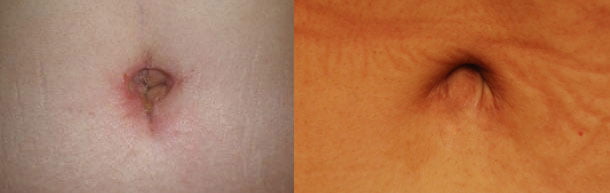
Dr. Hess’ attention to detail means more beautiful results for you.
What to expect after a tummy tuck
After a tummy tuck, your abdomen will be swollen for a few days and some pain is likely. Dr. Hess will prescribe a pain medication to alleviate any pain or discomfort. Surface stitches and deeper stitches are usually dissolvable and do not need to be removed.
Full recovery may take weeks or months, depending on the individual and procedure. Those with stronger abdominal muscles will find a shortened recovery as their body more easily adapts. Regardless of physical condition, it is crucial to implement a safe exercise program, as this will help reduce the swelling, lower the chance of blood clots, and work to further tone your new body.
Once you are fully recovered, a tummy tuck can produce excellent results, generally lasting as long as a balanced diet and regular exercise are maintained.
What is the TAP block and how does it help with recovery?
To reduce post-op pain for tummy tuck patients, Dr. Hess frequently uses the TAP block during surgery. The transverse abdominis plane (TAP) block is a peripheral nerve block designed to anesthetize the nerves supplying the anterior abdominal wall.
Anesthetic is injected between the internal oblique and transverse abdominis muscles between the plane through which the sensory nerves pass. Studies have shown that the TAP block reduces the need for postoperative pain medication and provides more effective pain relief. It also decreases post-surgery side effects related to pain medication such as nausea and vomiting.
- Read more about the TAP block for tummy tuck
Learn more about tummy tuck surgery:
- A great resource for real patient stories about tummy tuck surgery can be found on RealSelf.com, where Dr. Hess has also answered hundreds of patient questions about plastic surgery.
- You should also view our tummy tuck before and after photos to see real patients that have undergone a tummy tuck here at our Fairfax plastic surgery office.
Schedule a Consultation with Dr. Hess
If you are ready to explore your options for getting a flatter, firmer and better proportioned abdomen, contact us at Hess Plastic Surgery to schedule a consultation. Dr. Hess will discuss your goals and concerns and help you decide which tummy tuck may be right for you.